Alamo Colleges District Braids Three Funding Streams Into One Learner Journey
Alamo Colleges District's Economic and Workforce Development department does not pool its grant dollars. It braids them. Each funding source stays separately tracked and separately compliant on the back end, while the learner moves through one uninterrupted experience. myOneFlow is where that tracking lives.
By the numbers, as reported by Alamo Colleges District
$60M+
As of May 2026. Multi-year institutional and external funding under management in the Economic and Workforce Development department alone.
Up to $51M
As of May 2026. One of the largest programs in that portfolio: a local city program with heavy compliance requirements.
523
Spring 2026 term. Learners in GED across seven locations in that term alone.
900+
Annual rate at 2026 scale. Learners reached per year in GED and ESL alone.
About Alamo Colleges District
Alamo Colleges District is a network of five independently accredited colleges and five education and training centers, serving an eight-county region in and around San Antonio, Texas. The district enrolls more than half of all college students in Bexar County, and set an enrollment record of 87,757 students in fall 2025.
Inside the district, the Economic and Workforce Development department runs adult education and literacy, high school equivalency, English language instruction, workforce training, and continuing education. The education and training centers are embedded in the communities they serve and act as on-ramps from non-academic programs into academic ones.
Dr. Sammi Morrill is Vice Chancellor for Economic Mobility and Workforce Development at Alamo Colleges District and has served on the local workforce development board for about five years. She also previously led economic and workforce development for a surrounding city. Running the programs and sitting on the board that funds them shaped how Alamo approached its funding.
Fragmented Funding
For Alamo, the funding problem has not been the size of the budget. It has been the shape of it. Morrill describes her department's funding as abundant and, in the same breath, as fragmented. Each stream arrives with its own eligibility rules, documentation standards, reporting calendar, and outcome definitions. The easy response is to run each one as a separate program with separate staff.
Alamo found that approach expensive twice over. It duplicates services for the same person, and it pays for the duplication.
Not every program is in Alamo's position. Plenty of organizations are absorbing real cuts rather than sorting through abundance. But where multiple streams do exist, Alamo's experience is that coordinating them is the harder problem.
"Our funding is great, abundant, not only from federal and state level, but also, what I tell you is we have enough money, it's fragmented in how we utilize that money. A lot of times it's much easier when we think about the funding structure that we have to put this in these little boxes. And when we do that, we duplicate services, and not only duplicate services, but we're spending for those duplicated services."
— Dr. Sammi Morrill, Vice Chancellor for Economic Mobility and Workforce Development, Alamo Colleges District
42nd NAWDP Annual Conference, May 2026
Getting Off Paper Before the Pandemic
When Morrill arrived at Alamo Colleges about seven years before the 2026 session, learner records were still paper based. The department implemented myOneFlow and was fully launched roughly a year before COVID hit. The timing mattered more than anyone planned for.
For Alamo, the funding problem has not been the size of the budget. It has been the shape of it. Morrill describes her department's funding as abundant and, in the same breath, as fragmented. Each stream arrives with its own eligibility rules, documentation standards, reporting calendar, and outcome definitions. The easy response is to run each one as a separate program with separate staff.
Alamo found that approach expensive twice over. It duplicates services for the same person, and it pays for the duplication.
Not every program is in Alamo's position. Plenty of organizations are absorbing real cuts rather than sorting through abundance. But where multiple streams do exist, Alamo's experience is that coordinating them is the harder problem.
"The beauty of our timing was that we were fully launched right before COVID. So a year before COVID happened, we were already in a system, which also allowed us to not have any disruption in service. And really, we had an increase because of the way we did outward-facing inquiries with myOneFlow at the time."
— Dr. Sammi Morrill, Alamo Colleges District
The Final Straw: A 2021 Funding Surge
In 2021, the City of San Antonio launched its COVID-19 Workforce Development Recovery Strategy, and millions of dollars in additional funding moved into education and workforce programs across the region. In that period, Alamo's Economic and Workforce Development department more than doubled both its client count and its available grant funding, reaching $13.5 million for over 2,000 clients.
Before myOneFlow, many programs required learners to complete up to 20 separate forms, often re-entering the same information. That intake burden was a barrier to enrollment on its own. With a single self-service intake form that auto-populates the downstream forms staff need for enrollment and reporting, and a mobile app that lets applicants photograph and upload documents from a phone, the department could absorb the new volume without adding proportional data-entry staff.
"We had to scale our efforts in how we were going to serve our community. We needed a streamlined process. I wanted it to be as efficient as possible. I wanted to automate wherever I could automate. The more money you're spending on data entry that is a manual process, the less money is going to support that student."
— Dr. Sammi Morrill, Alamo Colleges District
The Need: Braiding, Not Blending
Over the five years leading up to 2026, the department settled on two commitments: collaborate better across the regional ecosystem to serve learners, and build internal infrastructure for clean co-enrollment and operational discipline.
Morrill draws a hard line between the two words. Blending pools money together. Braiding keeps it separate. Alamo does not pool funds and avoids blending due to the regulatory risk it poses. As she puts it, braiding is the most practical and compliant approach, and most grant agreements, including WIOA and adult education, already require it.
| Dimension | Blended Funding | Braided Funding |
| The dollars | Pooled into one pot | Kept separate, with each source keeping its own identity |
| Tracking | One combined view of the money | Outcomes and compliance tracked separately for each source |
| Risk | Carries regulatory constraints and is rare in practice because it can put the organization at risk | The practical and compliant approach, and already required by most grant agreements |
The Design Rule
Alamo does not pool funds. The braiding happens on the administrative side, where the learner never sees it. What the learner gets is coordinated delivery with no disruption in service.
"It's very important to me that on the back end is where the braiding happens, not on the customer facing end."
— Dr. Sammi Morrill, Alamo Colleges District
Mapping the Journey First
Braiding starts with the learner journey, not with the funding sources. Morrill's team maps the six stages of that journey, looks for the funding gaps along it, and only then goes after grants to fill those gaps. Each stage gets a primary payer and a supplemental payer, and the documentation is crosswalked so every funder can be shown its own outcomes.-1.png?width=2210&height=1135&name=image%20(9)-1.png)
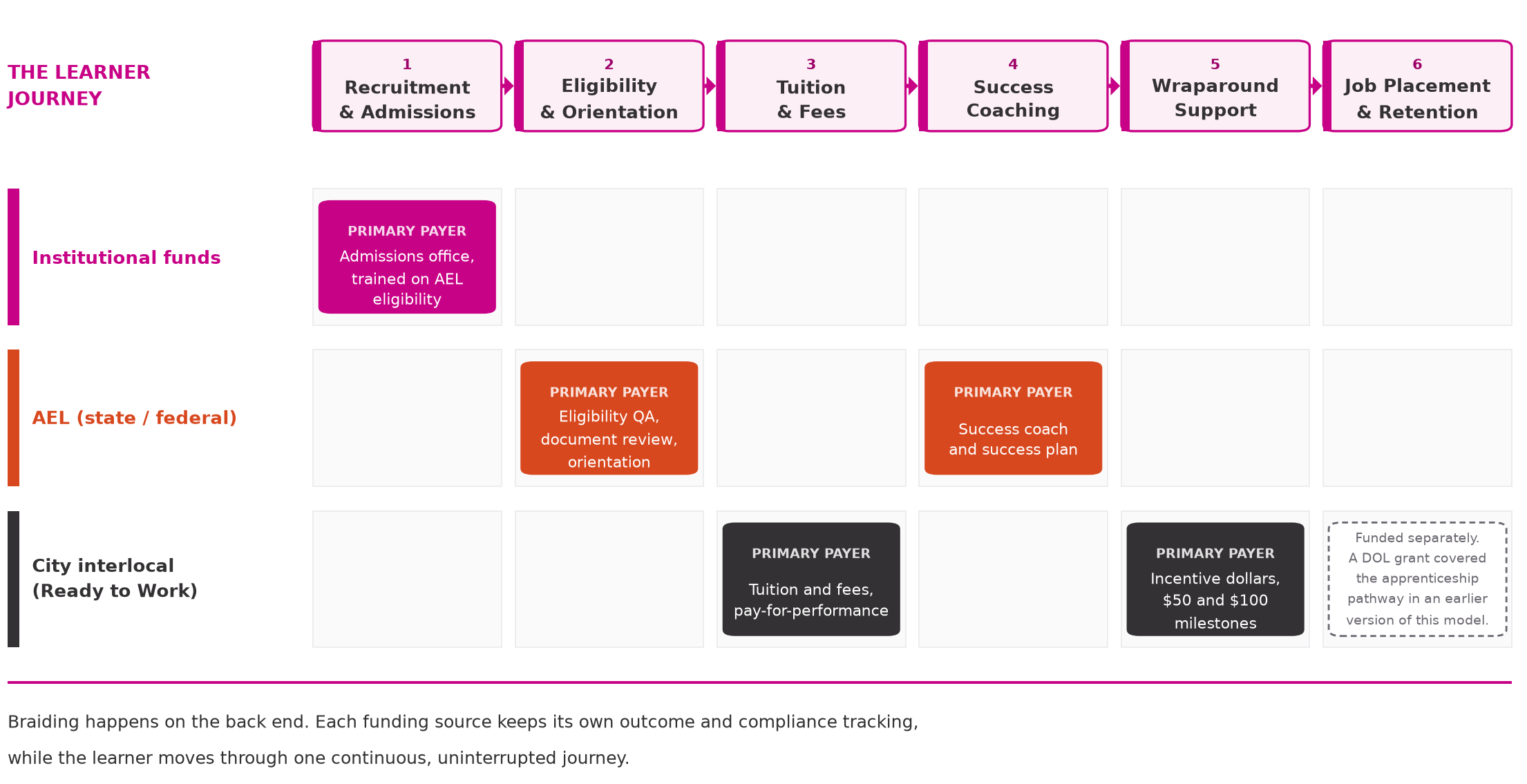
The department also changed its internal vocabulary. Grant dollars applied to tuition and fees are described as a form of financial aid, so applying them to a learner carries the same procedural discipline as any other tuition payment. Alamo also says success coaching rather than case management: each learner has a success plan and a named success coach.
"Where we are today is that we call them financial aid, because they are a form of financial aid. So they may strengthen other parts of that journey, but in essence if they're paying for tuition and fees, that is a form of financial aid and we should treat the process the same."
— Dr. Sammi Morrill, Alamo Colleges District
Three Funders, One GED Program
The clearest illustration is Alamo's high school equivalency program. In the spring 2026 term alone, the department served about 523 individuals in GED across seven locations. At that scale, the department reaches roughly 900 or more learners per year in GED and ESL alone.
Historically, adult education and literacy operated as a siloed team doing its own admissions and its own eligibility. Under the braided model, three funding sources each pay for a specific segment of the same journey.
| Funding Source | What it Pays for |
| Institutional Funds | The non-academic admissions office that receives every GED inquiry, trained on adult education eligibility, documentation, and applications. Also funds grant managers, grant monitors, and in some cases data analysts. |
| Adult education and literacy (state and federal) | Quality assurance on eligibility and documentation, plus the success coach who delivers wraparound services and owns the success plan. |
| City of San Antonio interlocal agreement | Tuition and fees, and milestone incentive dollars. Structured as pay for performance rather than a grant, with specific performance markers. Alamo leaned on this local funding for tuition and fees at a point when it was not clear federally whether adult education would be funded. |
The internal referral, step by step
-
An institutionally funded admissions staff member takes the inquiry and starts the record in myOneFlow, completing profile fields that speed up the documents going back out.
-
The applicant is asked whether they want to apply for adult education and literacy. Attaching that funding in myOneFlow automatically releases the right application and enrollment forms and the document upload list to the applicant.
-
The applicant completes everything online, including from a phone, signing with a finger or stylus. CASAS, academic assessment, and digital literacy are completed.
-
The completed package moves as an internal referral in myOneFlow to the adult education funded team, which performs quality assurance on eligibility documentation and signatures and clears the learner for orientation.
-
Registration proceeds. In the student information system, the learner record is tagged against the City of San Antonio local dollars for tuition and fees, while the success coach shown in myOneFlow is visibly funded by the adult education stream.
Incentives tied to milestones
Alamo requested incentive dollars inside the interlocal agreement with the city, tied to measurable skills gains. As designed under that agreement, a learner who passed two GED subtests earned a $50 gift card, and a learner who completed the full four-subtest suite earned $100, for up to $150 across the credential.
Sequencing Note
The outcomes in the interlocal application were written to line up with adult education outcomes before any dollars arrived. Morrill's point: if you plan to braid, you have to know how you will write the other grants up front, before you ever get the money
What Had to Change Behind the Scenes
Morrill's rule is that the fiscal and compliance practices have to be in place before you launch, not built up grant by grant. Waiting, she says, makes every new award slow to get off the ground.
-
Institutionally funded compliance staff. Grant managers, grant monitors, and in some cases data analysts are funded institutionally, on the standing expectation that the department will carry grant dollars every year. That removes the lag of staffing up for each new award.
-
Allowable cost discipline. Allowable and disallowable costs are settled up front, along with participant eligibility tracking.
-
Centralized oversight and internal audits. The adult education grants sit in one grant manager's portfolio. Staff pull learner records and outcomes from different systems and check that they line up.
-
Common language across teams. In the year leading up to the 2026 session, the department built shared definitions for the terms that silo grants, so a measurable skills gain means the same thing to a WIOA staffer and an adult education staffer. Alamo treats it as a success point on a learner's success plan.
-
Quality assurance ahead of scale. One of the largest programs in the portfolio, a local city program running up to $51 million as of May 2026, carries heavy compliance requirements. The assurance layer had to exist before the volume arrived.
Why the Data System Matters
Morrill is direct about this one: braiding will fail without a strong data system. Alamo runs a student information system for academic records. It runs myOneFlow for the things a student information system was never built to hold: industry-recognized credentials and employment outcomes on the same learner record, service history, fiscal detail per learner, and the internal referrals that move a person between funded teams.
In myOneFlow, staff sees one record that carries every service, every funding attachment, every task and message, measurable skills gains, and employment and wage outcomes after exit. Over the couple of years leading up to 2026, the team also used activity codes in the student information system to tag tuition and fee braiding at the learner level.
"There isn't a system I've seen, a student information system, that has the ability to track industry-recognized certifications and employment within the same student record. And that's key when we talk about this data infrastructure in myOneFlow. We have this back end for fiscal, but we also have the ability in one record. That's the other beauty: you're seeing [the] full learner record from all services, financial and outcomes."
— Dr. Sammi Morrill, Alamo Colleges District
We never paused because we had braided dollars.
Dr. Sammi Morrill
Referring to 2025, when other programs had to close their doors or pause services
Services That Stayed Open
Because the interlocal outcomes had been aligned to adult education outcomes from the application stage, the department earned rollover dollars and additional dollars off the pay-for-performance agreement. Morrill says those dollars sustained Alamo's programs in 2025, when other programs had to close their doors or pause services. Alamo never paused.
The pressure that year was real and public. Federal adult education grants scheduled to arrive on July 1, 2025 were delayed for nearly two months nationally, and eligibility rules changed mid-cycle. Alamo held its enrollment target of roughly 900 students anyway. Speaking to the San Antonio Report that August, Morrill said the district had rolled over close to $500,000 in city and institutional dollars from the prior year, and that those dollars alone let the department sustain its people and keep intake and enrollment open. The advantage was not a larger budget. It was having already built the structure to move other dollars into the gap.
Training the Team on the Money
Morrill's view is that you cannot train a team on braiding by talking about it. Staff need something in hand. Alamo built a color-coded map of the learner journey, from connection through entry, progress, and success, with each funding source in its own color, so staff could see which dollars pay for which milestone. In an earlier version of that map, a Department of Labor grant covered the apprenticeship piece.
The point of the map is that no learner gets dropped at a funding boundary, even when the payer changes.
Planning for the Future: From Transactional to Transformative
The department continues to extend the model. Morrill envisions a single learner application for grant eligibility that automatically generates the list of funding the person qualifies for, so a learner can be matched to support at every step from adult education classes through job placement.
"That's where we're looking internally, to see how we can create efficiencies and centralize all of our compliance, all of our reporting in one system."
— Dr. Sammi Morrill, Then Associate Vice Chancellor of Operations, Economic & Workforce Development, Alamo Colleges District (2021)
Case studies
Read More Success Stories
Serving more job seekers and accessing 6x more funding
Employ Prince George’s used myOneFlow to grow staff by 311%, increase funding sixfold, and create a scalable, fully digital workforce development system that could serve more job seekers.
Doubling client capacity and reducing intake time
A workforce agency in metro Virginia transformed its operations with myOneFlow, doubling client capacity, cutting enrollment time in half, and creating a fully virtual, accessible, and efficient service model.